

Building in the Open
Today we're launching the Bybit Tech Blog, a place where our engineering team will share how we build, what we've learned, and where we're going.
Since returning as CTO, I've been thinking about a simple question: what kind of technology company does Bybit need to become next? The answer starts with how we build, how we learn, and how openly we share that work. This blog is part of that effort.
The Turning Point
On February 21, 2025, Bybit suffered one of the largest crypto incidents in the industry's history.
Bybit grew with a strong product-first culture. We moved quickly, shipped features, and scaled fast. For me, the lesson is not that we should stop moving fast. Speed is part of Bybit's DNA. The lesson is that speed has to be supported by solid engineering foundations, for a global financial platform where security, reliability, and trust are indispensable.
Becoming a Technology-Driven Company
Engineering cannot sit behind the product. It has to be part of the product.
That leads to one of the commitments I care most about as CTO: Bybit must become a genuinely technology-driven company. For a financial platform operating around the clock, technology is not a support function. It is fundamental to the product and the business. Our priorities are straightforward: improve scalability and reliability as trading volumes and products grow, strengthen the architecture protecting customer assets and data, modernize our engineering practices, and make AI a meaningful part of how we build and operate.
Over the past few years, I've watched AI dramatically expand what engineering teams can do. The shift goes far beyond productivity. That's why our longer-term ambition is to make Bybit an AI-native financial platform.
Finance is a natural domain for AI. It is real-time, data-heavy, risk-sensitive, and decision-intensive. Crypto made markets more accessible. DeFi reduced reliance on traditional intermediaries. We believe AI can help narrow another gap: in knowledge, analysis, risk management, and execution. A retail user with $5,000 and an institutional desk managing $500 million may have access to the same order book, but they don't have the same analytical capabilities, risk frameworks, or execution disciplines.
For us, being AI-native means more than adding AI features to an exchange. It means integrating AI across the platform, from how engineers build systems, to how we manage risk, to how users interact with their assets.
Why a Tech Blog
If we're serious about that transition, we also need to be more open about how we build. Historically, Bybit has been better known for its products than its engineering. I want to change that, but you don't build a technology brand by simply calling yourself a technology company. We have to show the work.
That is what this blog is for.
In the coming months, we will go deeper into areas including:
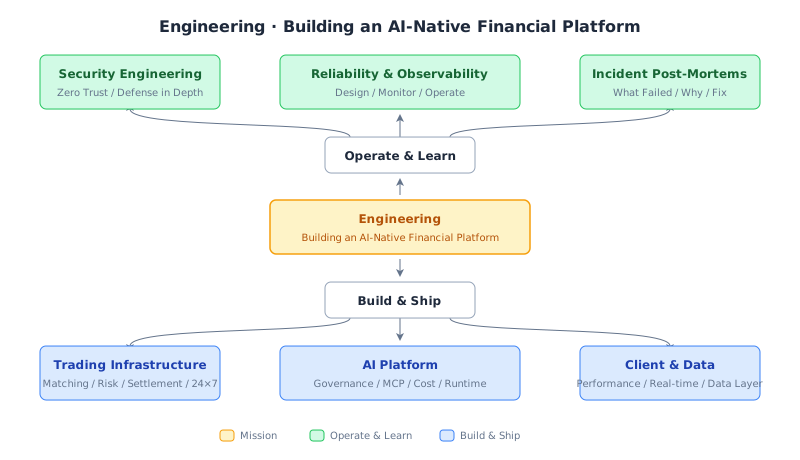
- Trading infrastructure: Matching engines, risk systems, settlement, and operating markets 24/7
- Security engineering: Zero trust, defense in depth, and lessons from real-world incidents
- AI platform architecture: Model governance, MCP, cost control, and running AI in production
- Reliability and observability: How we design, monitor, and operate systems where downtime directly affects users
- Client and data infrastructure: Performance, real-time systems, and the data layer behind the platform
- Incident postmortems: What failed, why it failed, and what we changed afterward
Most importantly, these posts will increasingly be written by the engineers doing the work. The goal is not to make Bybit sound technical. It is to make our engineering work visible.
An Invitation
We're opening up more of what we build, starting with KaaS. But open source is only the beginning. Use what we release. Break it. Improve it. Question our decisions. Show us a better way.
We have a lot to build.
Come build with us.
Let's build in the open.
Rockman Zhang
CTO, Bybit